122 km
Length of the course of the Ulhas river. A river that has its beginnings in pristine streams flowing down from the Western Ghats at Rajmachi near Lonavala, the Ulhas ends as a smelly creek in the Arabian Sea.
3
districts that the river flows through - Pune, Raigad and Thane. Inhabitants of its banks use it for various purposes including washing clothes and fishing. The river flows through Khandala valley and interior Karjat. It then flows through Bhivpuri, Neral, Badlapur, Ambernath, Ulhasnagar, Shahad, Kalyan and Dombivli before joining the the Vasai creek and, eventually, reaching the Arabian Sea.
6
Cities that the Ulhas river supplies potable water to - Kalyan, Dombivili, Badlapur, Navi Mumbai, Ambernath and Ulhasnagar. As also many villages on the river boundary starting from Karjat to Kalyan. Residents of Kalyan-Dombivli and 27 villages need 360 MLD of water, 320 of which is drawn from the river.
20x
of permissible limits - the values of biochemical oxygen demand (BOD) and chemical oxygen demand (COD) This is due to untreated domestic and industrial effluent from Kalyan-Dombivli, Ambernath, Ulhasnagar, and Kulgaon-Badlapur that heavily pollutes the river as it makes it final stretch before meeting the Arabian sea near Mumbai.
30%
Percentage of the 126 million litres a day (MLD) sewage generated daily that is treated by the Kalyan-Dombivli Municipal Corporation (KDMC) before it is released into the river. Up from 10% in 2016.
80%
Percentage of the 80 MLD sewage treated by the Ulhasnagar Municipal Corporation. Up from 0% in 2018!
90%
Percentage of 18 MLD treated by the Kulgaon-Badlapur Municipal Council. Up from 40% in 2016.
97%
Percentage of waste and sewage water that is treated by the Ambernath Municipal Corporation. Untreated water continues to be released into the river. This is a significant improvement from 2016 when it was around 60%.
Rs. 100 crore
Amount the state government is supposed to spend on restoration of Ulhas and Waldhuni rivers, according to a 2017 ruling by the Supreme Court.
Apr 2019
Stalin D, Director, Vanashakti, carried out site visits and reported - "At Ambarnath, where the water is diverted to the sewage treatment plant (STP) we found that the chamber was broken and instead of the water flowing to the STP, it was directly entering into the river".
Apr 2019
Stalin D, Director, Vanashakti, carried out site visits and reported that the system of pumping at the Khemani Nullah was not automatic but manually operated, which is not reliable as even few hours of non-functioning in peak hours can cause overflow directly into the river.
Feb 2020
Number of sampling points increased from 4 to 11 after sustained pressure by activists and non-governmental organisations such as the Ulhas River Bachao Kruti Samiti. The sampling spots include: 1) spot before the Ulhas river flows into Barvi dam, 2) spot after the river merges with the dam water, 3) Barvi dam road in Badlapur below the Ulhas river bridge, 4) Ulhas river banks at Jambhale phata, 5) Ulhas river bank at Dhone village and 6) spot below Mohali bridge, 7) spot in Nevali village, 8) Kalyan creek near Durgardi bridge in Kalyan (West), 9) Jambul stream, 10) spot in Badlapur and 11) NRC bund.
Feb 2020
Kalyan-Dombivli Municipal Corporation (KDMC) informs the Supreme Court that it is augmenting its sewage treatment facilities by adding five sewage treatment plants (STP) to its current three. The court was hearing a petition filed by an environmental group.
Mar 2020
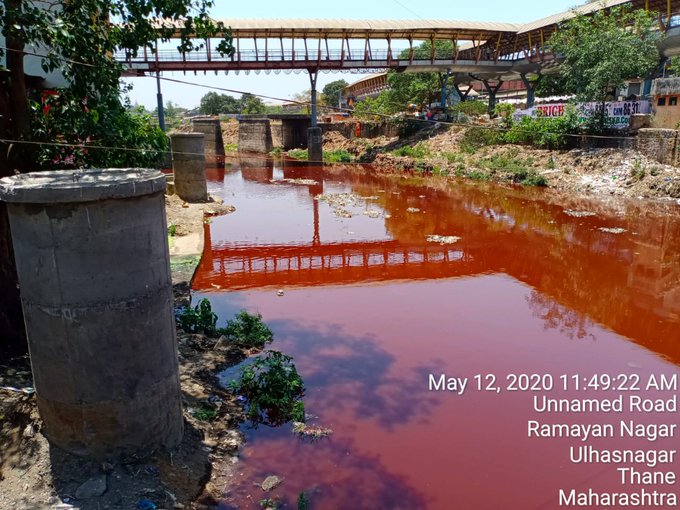
Local residents report water in Waldhuni river turning red due to industrial discharge from units in Ambernath, despite the COVID-19 lockdown being enforced. The red colour seems to be coming from either dye industries or bulk drug-producing (pharmaceutical) plants,” according to SL Waghmare, regional officer, MPCB. Units engaged in production of sanitizers could be responsible.
May 2020
Maharashtra Pollution Control Board (MPCB) fines operators of the privately-run Badlapur Common Effluent Treatment Plant (CETP) Rs. 5 lakhs for releasing untreated industrial waste into the Waldhuni river which caused its water and that of the Ulhas river turn red. (Note: Waldhuni is a tributary of the Ulhas river).
Jun 2020
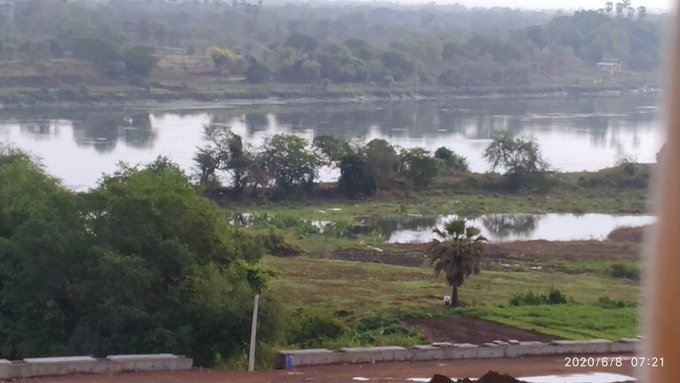
Noticeable increase in the girth of the river at Khadakpada Kalyan reported. Spill over noticed to form a temporary pond as seen in front of the trees in attached image.
 Last Modified: 09-Jun-2020 8:03 AM